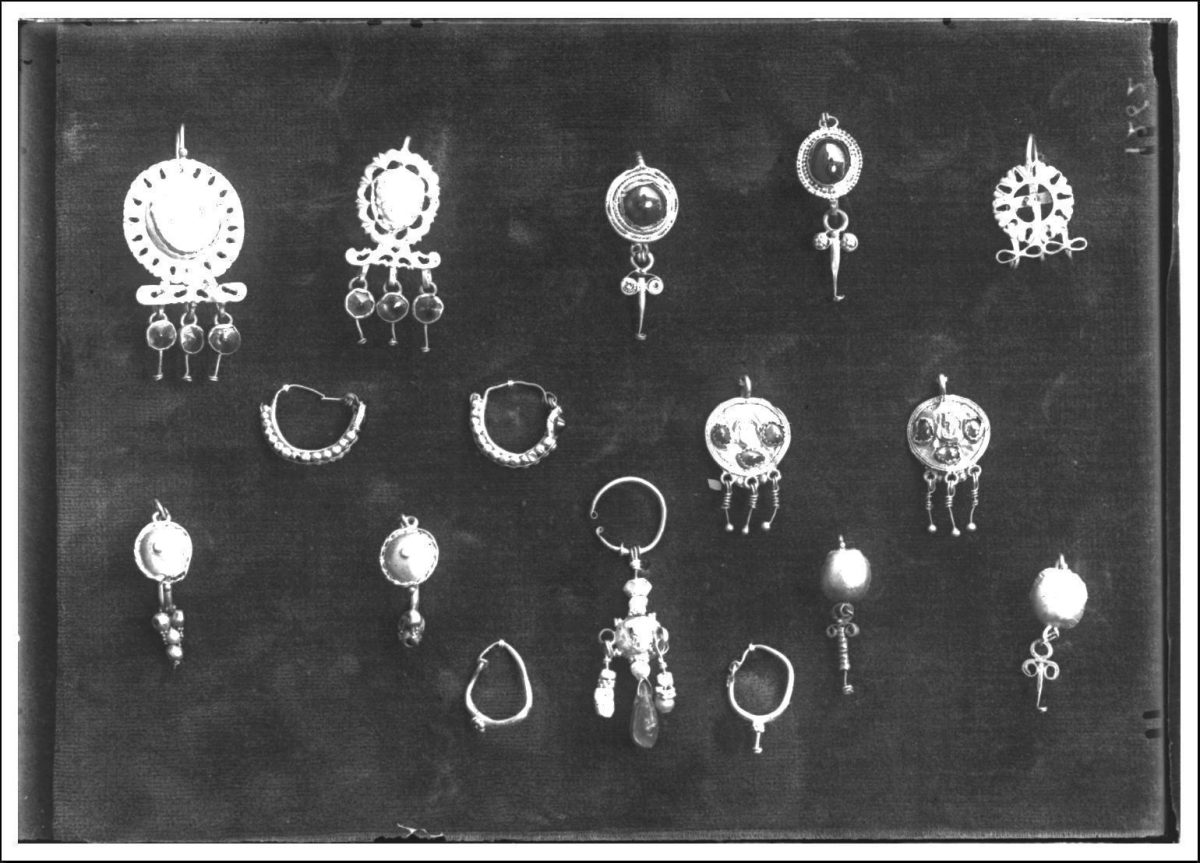
Photo ©Institut Français Du Proche-Orient (ifpo) https://media.hal.science/hal-03041920v1
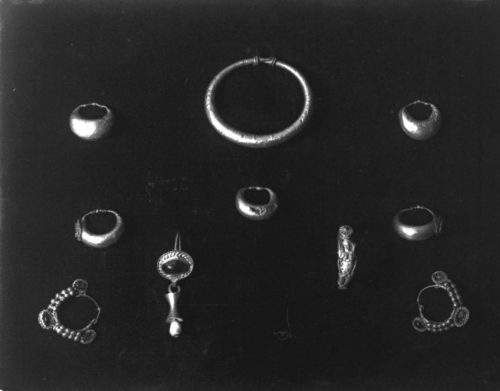
https://media.hal.science/hal-03042056v1
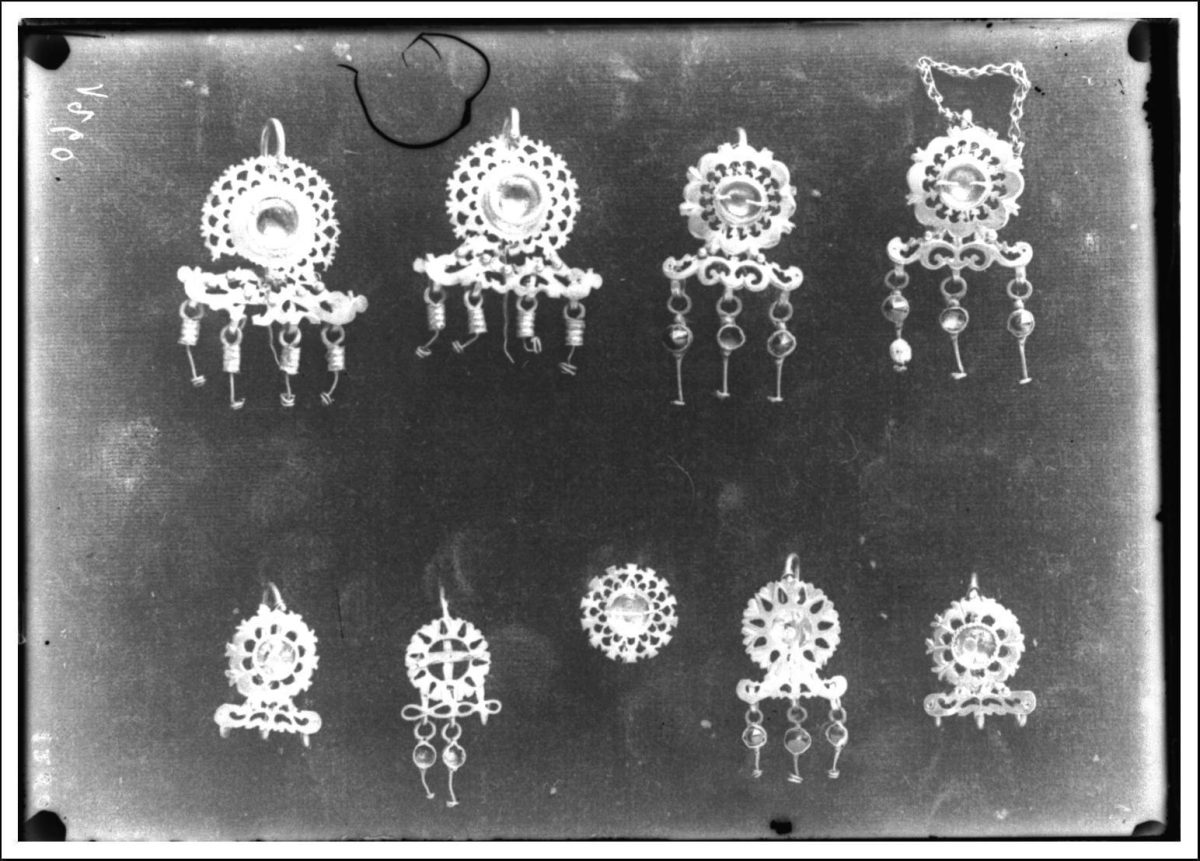
Photo ©Institut Français Du Proche-Orient (ifpo)
https://media.hal.science/hal-03041387v1
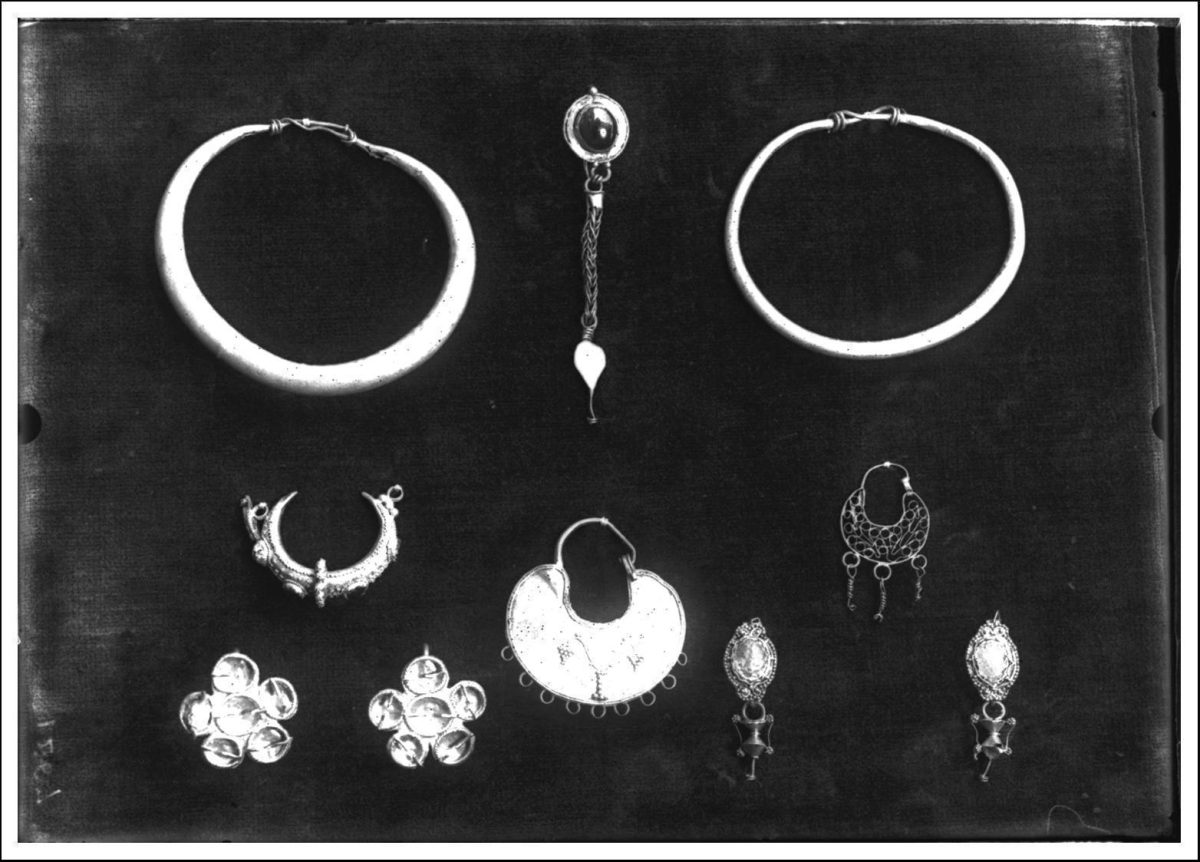
Photo ©Institut Français Du Proche-Orient (ifpo)
https://media.hal.science/hal-03041933v1
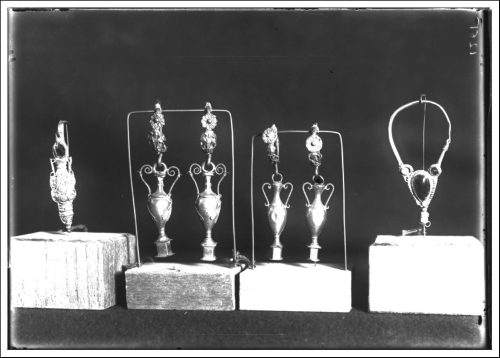
Photo ©Institut Français Du Proche-Orient (ifpo)
https://media.hal.science/hal-03041391v1
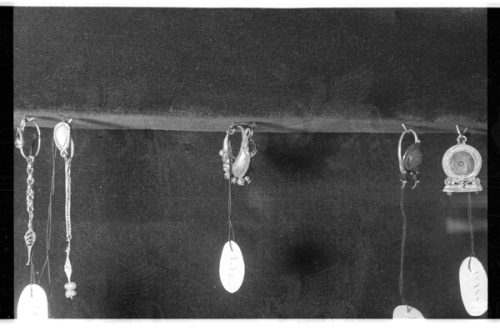
https://arachne.dainst.org/entity/5943000
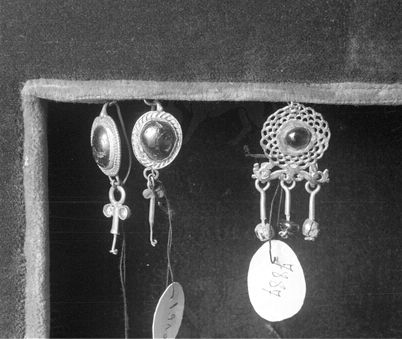
https://arachne.dainst.org/entity/5942990
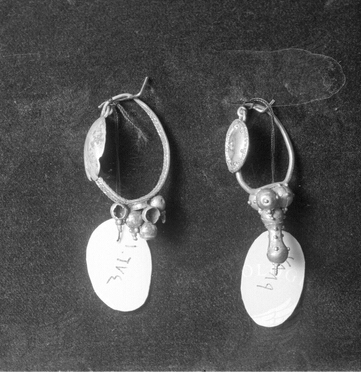
https://arachne.dainst.org/entity/5942998
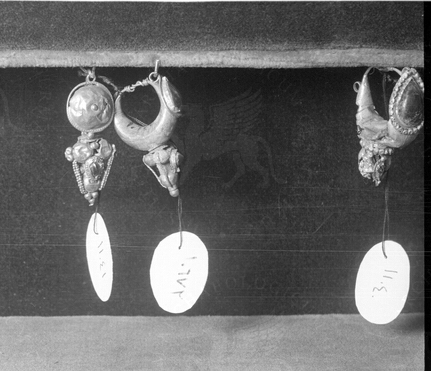
https://arachne.dainst.org/entity/5942994
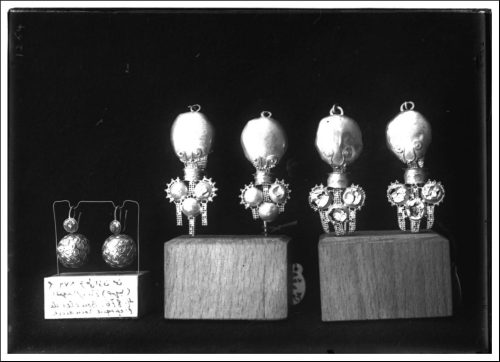
https://media.hal.science/hal-03041926v1
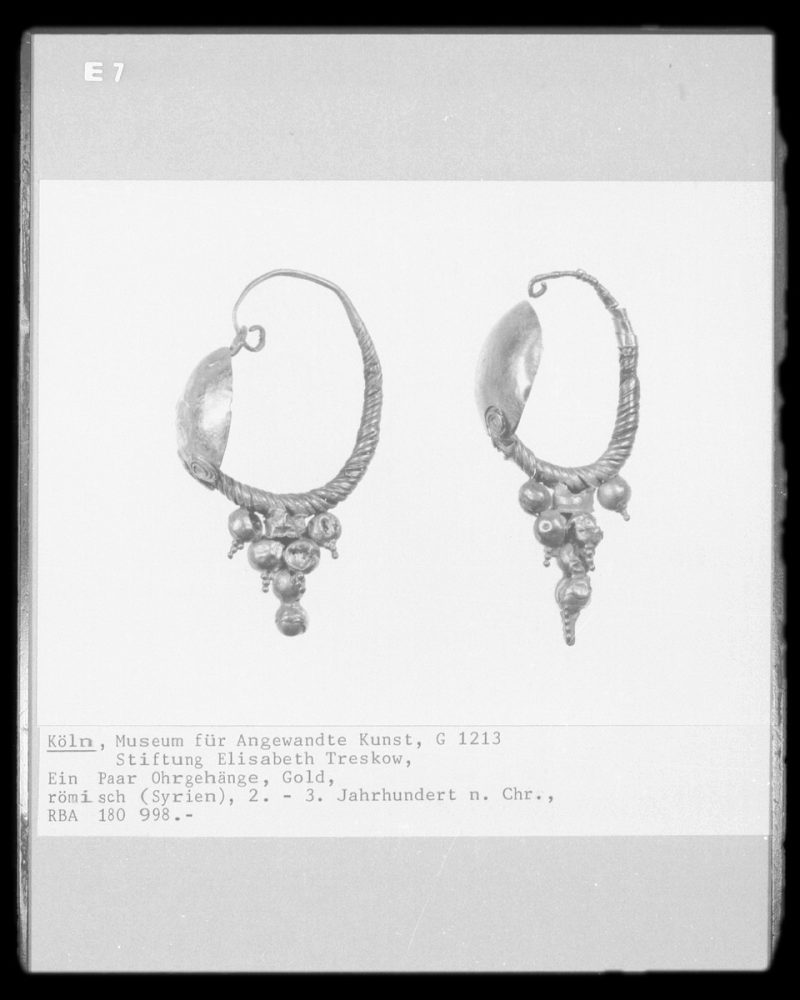
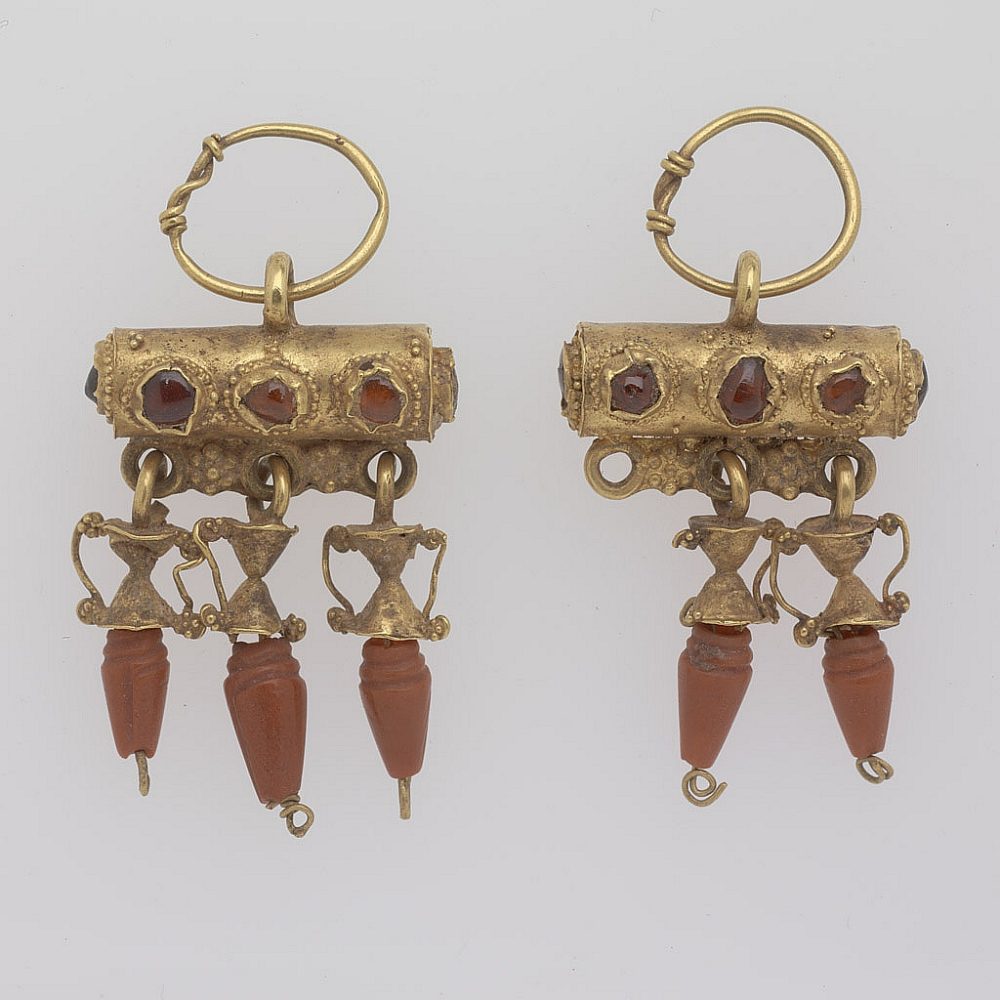
“These earrings are formed of a hollow oval that conceals the ear loop behind it. They have as pendants stylized clusters of hollow grapes ornamented with very small gold granules. The geometric grape design in many variations was popular throughout the Roman Empire in the second and third centuries.”
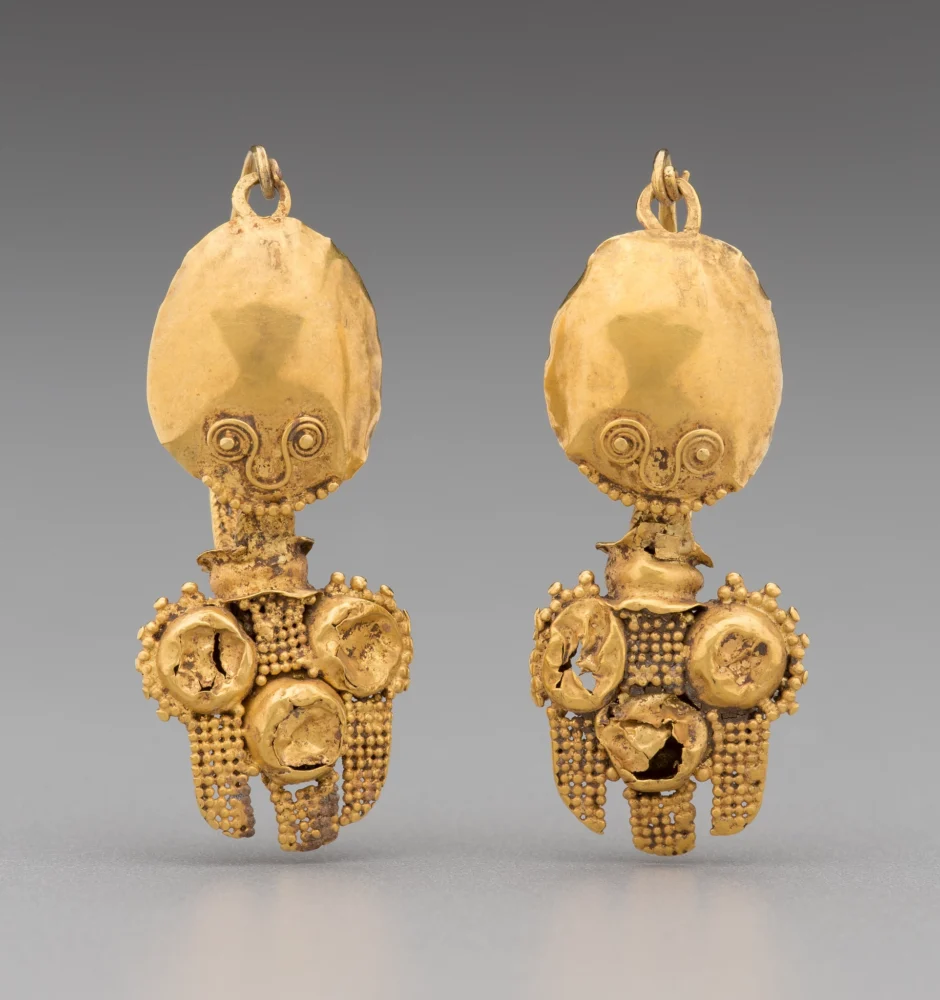
Detroit Institute of Arts, City of Detroit Purchase, 27.274.B.
https://dia.org/collection/earring-59192
Similar https://www.britishmuseum.org/collection/object/G_1914-1014-1
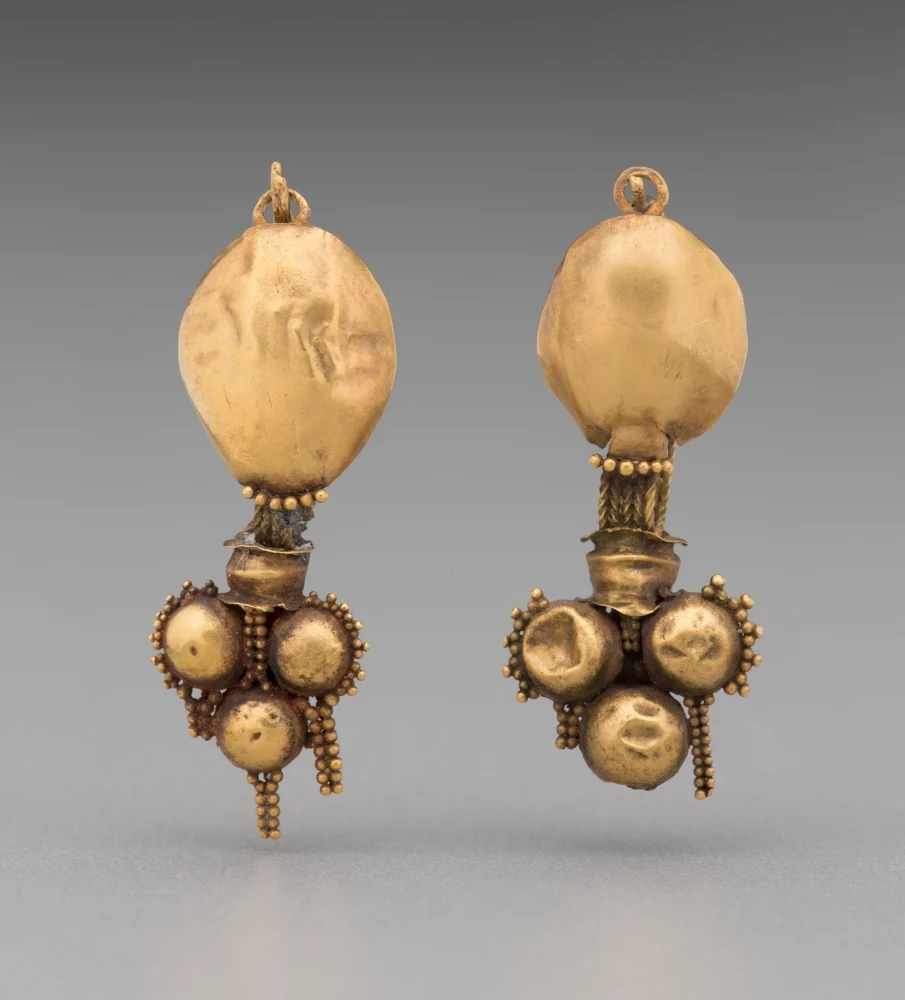
Detroit Institute of Arts, City of Detroit Purchase, 27.275.B.
https://dia.org/collection/earring-59193
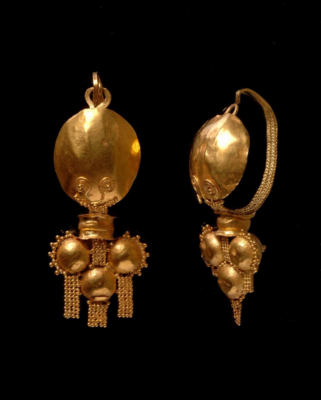
Rijksmuseum https://www.rmo.nl/collectie/topstukken/twee-oorhangers/
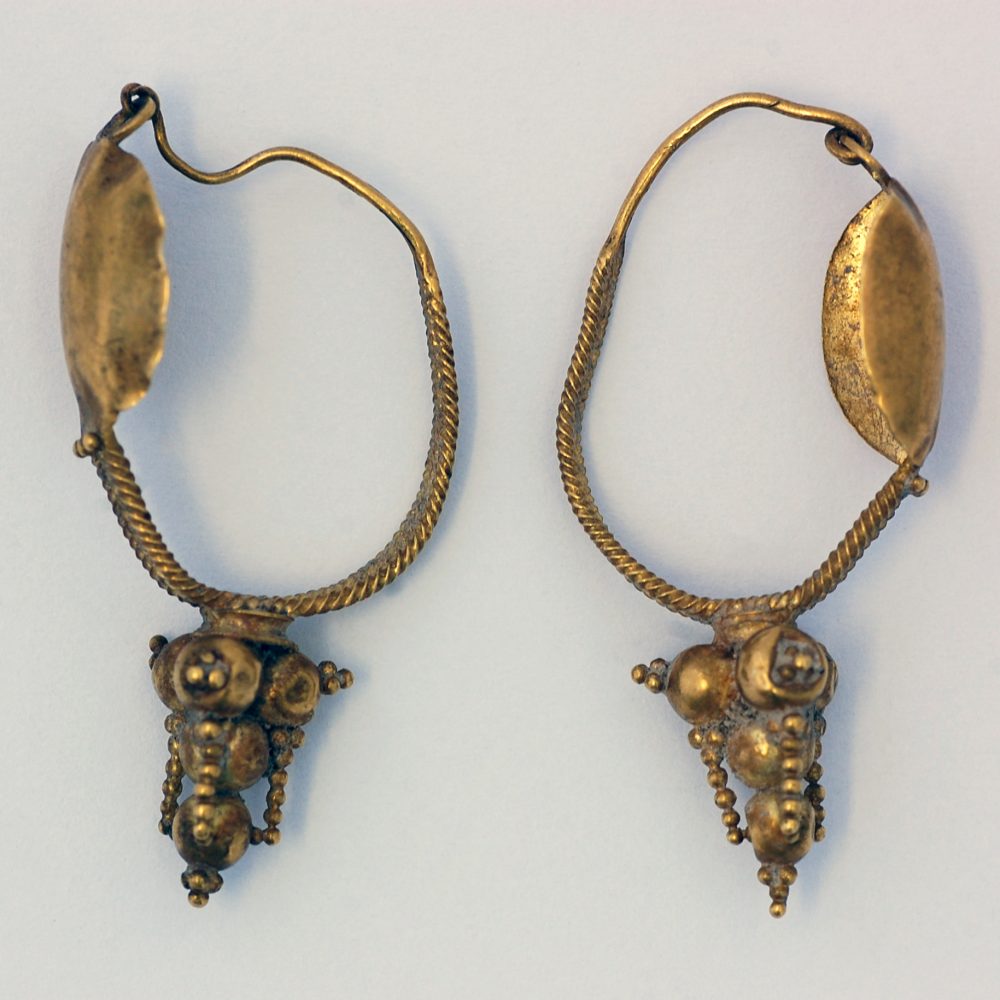
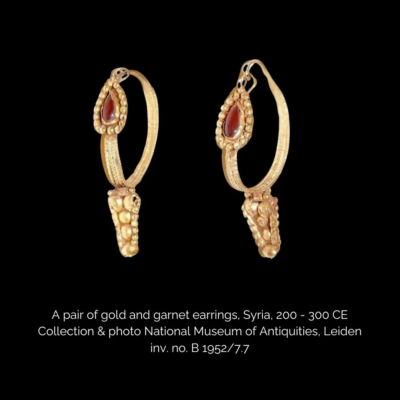
“Two shield-shaped earrings, each consisting of four gold beads. They are made according to a local Syrian design, in the form of an oval shield on a tapering braided band. The shields are decorated with an omega-shaped double spiral of twisted wire. Below the shields are three small round beads, decorated with hanging strips of small gold beads granulated in a technique.
These two gold earrings come from Hauran (Syria) and date from 200-300 AD. At that time, Syria was a province of the Roman Empire. The earrings are in the shape of a shield on a tapering braided band. The shields are decorated with an omega-shaped double spiral of twisted gold wire. Below the shields are three small round gold beads, decorated with hanging strips in the granulation technique of small gold balls. Although Syria was already part of the Roman Empire, this was a local Syrian design. Many examples of similar earrings of various sizes have been found. These earrings were acquired by the museum in 1952. This text was written in 2025 and is based on: P. Akkermans et al., Schitterend Sieraad, 2007, p. 38.”
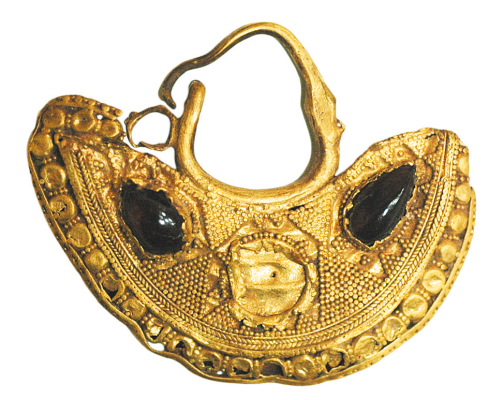
Gold crescent earring with inlaid gemstone, Tell El-Qita (Aleppo), Hellenistic period (312 – 63 BCE), 2.59 x 3.21 x 0.2 cm.
https://icom.museum
Pair of gold earrings with bids [doves?], inlaid with garnet.
Roman period, 1st / 2nd century, Dair al-Hadjar (Hauran). 4.7 x 6.1 cm
National Museum Damascus 2545/5119
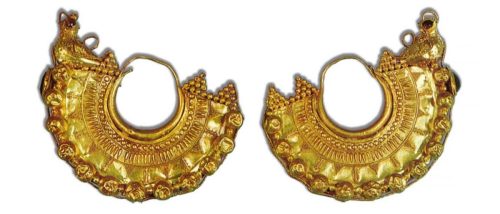
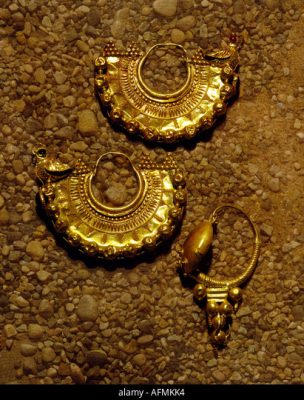
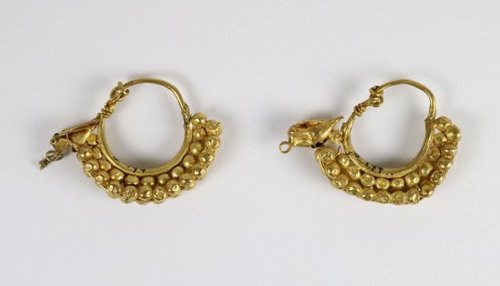
Crescent-shaped earrings with birds [dove?]
1st C BCE – 1st C CE
length 4.4 cm, Height 2.3 cm
A row (11 or 12) of hollow gold balls is soldered to an oval-shaped, thin gold tube, the ends of which are intertwined with each other. To these, in turn, hollow gold balls are soldered in pairs next to each other (12 or 13), with a round wire running between them (to conceal soldering points?). On the front balls is a bird made of thin gold sheet, with a ring (and the end of a chain – this one made of brass?) in its beak. The folded wings are in the shape of an ivy leaf or heart, lined with cord wire.
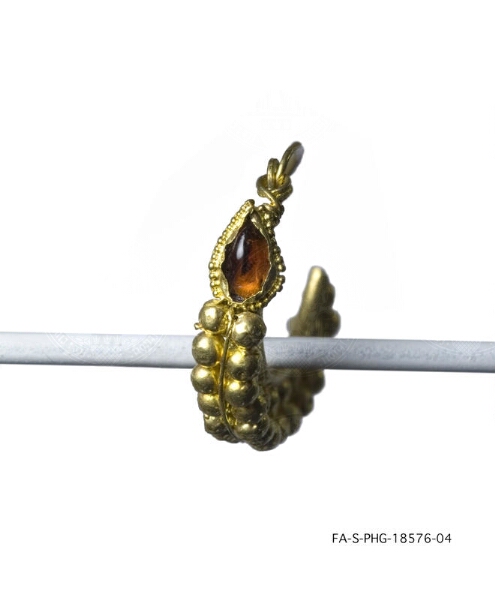
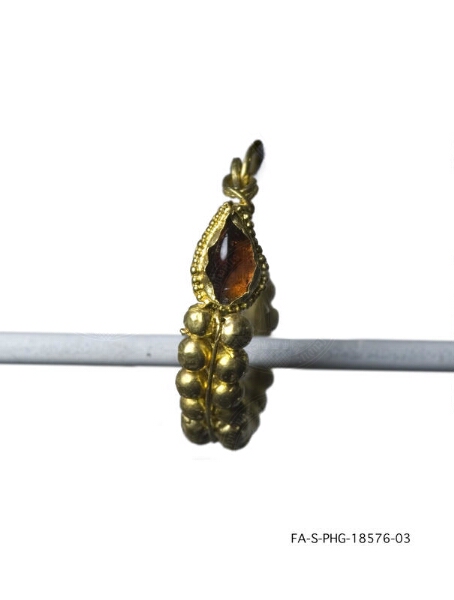
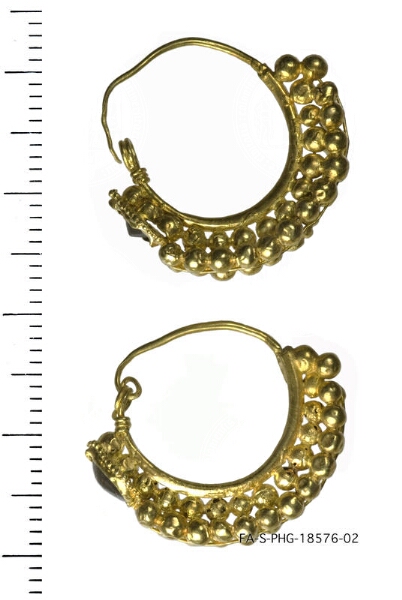
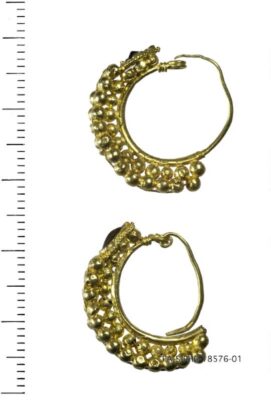
Earrings with carnelian, 1st C BCE – 1st C CE
Deutsches Textilmuseum, Krefelder Scherben, Inv. nr. 12674 A, B – H. 2 cm; W.: 2,1 cm. Carnelian bezel: H. 0,7 cm; W. 0,45 cm
Provenance: Cathrin Harald-Sameh, Ronco, Schweiz, probably from Syria, without context.
Kölner und Bonner Archaeologica, KuBA 2 / 2012
https://www.iak.uni-bonn.de
“The two earrings form a set and consist of three elements: a gold ring, a flexible bent wire that is threaded through the ear hole, and a drop-shaped carnelian in a gold setting. A semi-circular bent tube with a diameter of 0.11 cm forms the decorative rail, on the side of which a row of fourteen hollow balls of the same size are soldered. Two further parallel rows of twelve balls each are attached to this. They are arranged next to each other, and a thin gold wire runs between them. In cross-section, the three rows of balls form a small pyramid. Towards the rear end of the ring, the number of balls is reduced to two, one on top of the other. An area is left out at the front for the drop-shaped decorative setting. This is made of gold sheet, which is folded over onto the front of the stone and decorated with a surrounding wire made of balls (diameter 0.05 cm). The gemstones of the two earrings differ in color. One has a dark, slightly bluish red, which is more like a garnet, the other has a more reddish brown color like a carnelian. Both stones are, however, cut in the same way. They are raised and pointed in the middle area. Due to several almost identical earrings, whose Syrian origin is considered certain, it can also be assumed that these come from the eastern Mediterranean.”
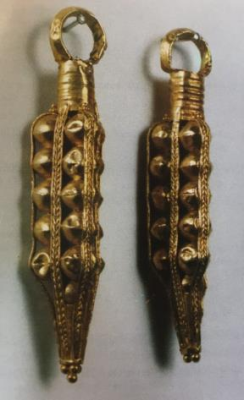
© Syria, the first discoveries in history: Expo. Seville 92, 1992
After: Mathilde Autret, L’archéologie orientale dans les Expositions universelles de 1855 à 2015.
https://dumas.ccsd.cnrs.fr [part 3]
https://bedouinsilver.com
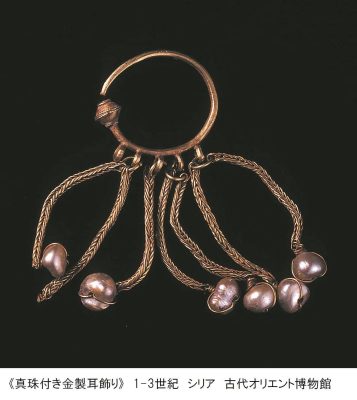
1st-3rd century earrings from Syria, gold and pearls.
The Ancient Orient Museum, Tokyo, Japan
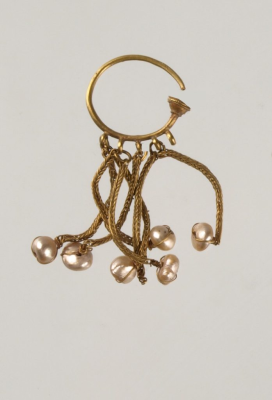
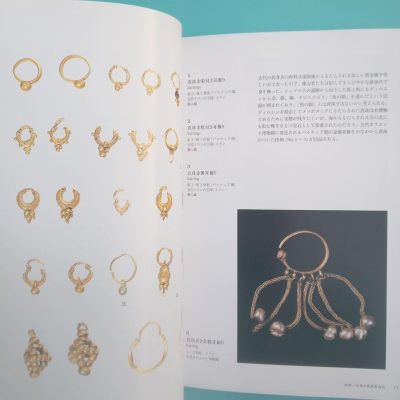
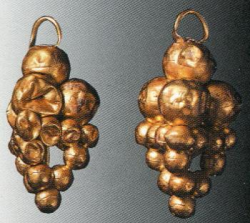
https://nekoarena.blog.fc2.com/blog-entry-946.html
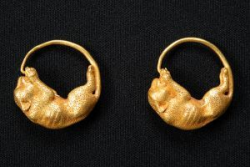
https://www.city.okayama.jp/orientmuseum
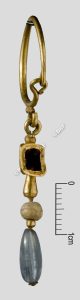
Earrings, gold, amethyst; 2nd-3rd century, Tartus, Syria
H: 2.7, 2.9 cm
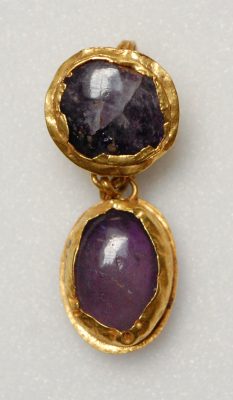
BM 1879,0115.17
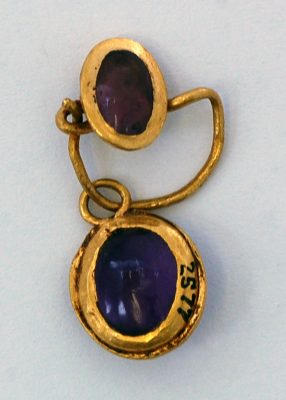
BM 1879,0115.16
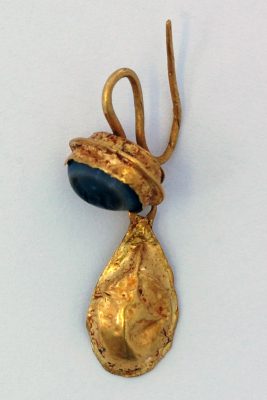
BM 1879,0115.15
Gold, sardonyx, H: 3,6 cm, 1st-3rd century, Tartus
Pair of earrings, gold, emerald, sapphire, pearls. H: 52.5-54 mm
3rd-1st century BCE
Found: Necropolis of Tortosa, Phoenicia (now Tartus in Syria)
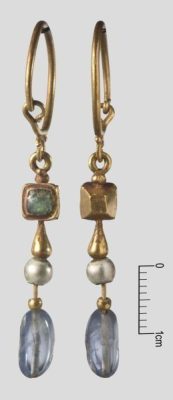
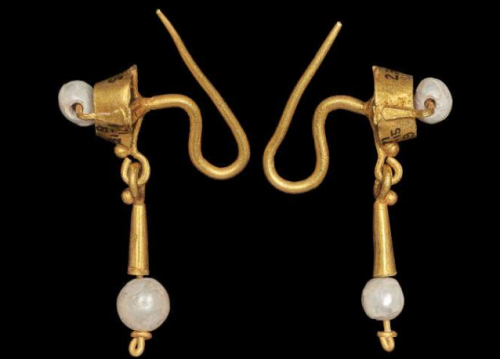
Gold earrings, truncated conical box-setting with a wire across the top threaded with a pearl; at the back are soldered two intersecting ribbons, attached to which is a hook with a pendant in the form of an expanding gold rod with a pearl at the end.
Tartous, Syria, 2nd century
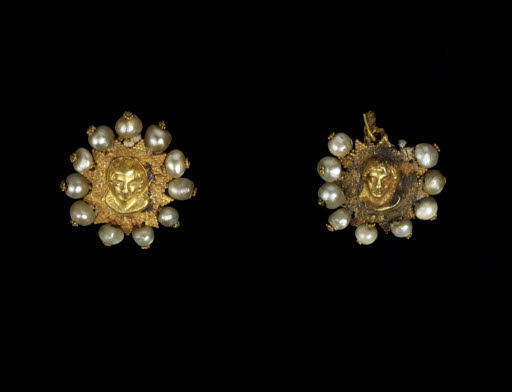
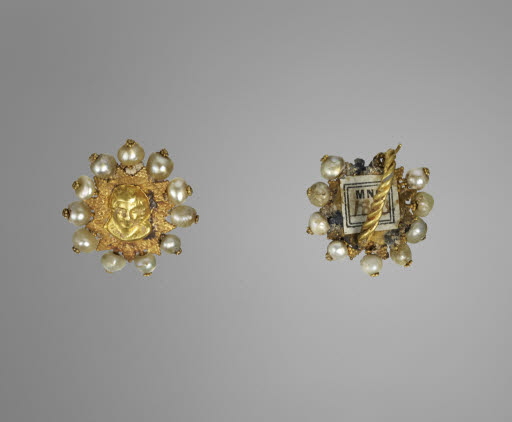
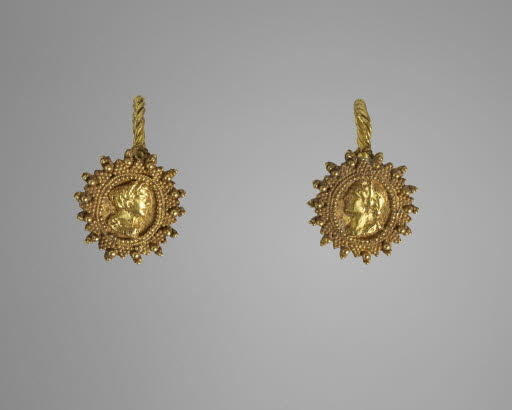
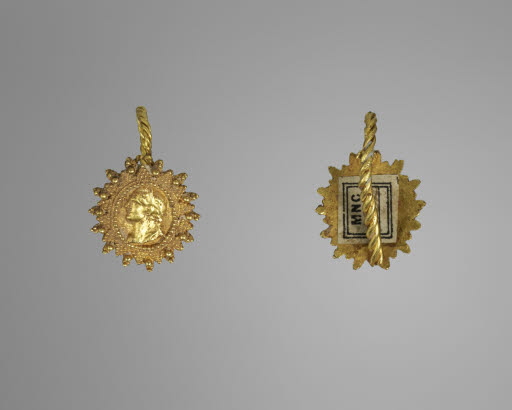
https://collections.louvre.fr/ark:/53355/cl010288734
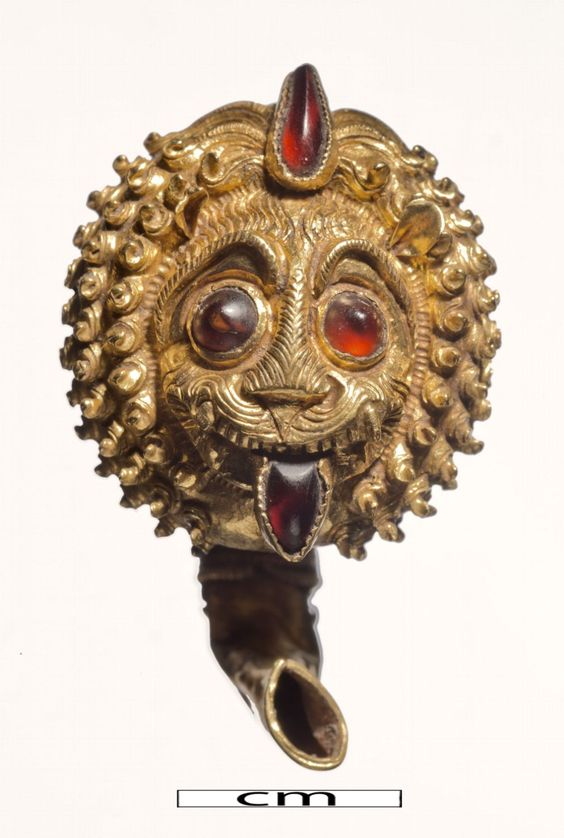
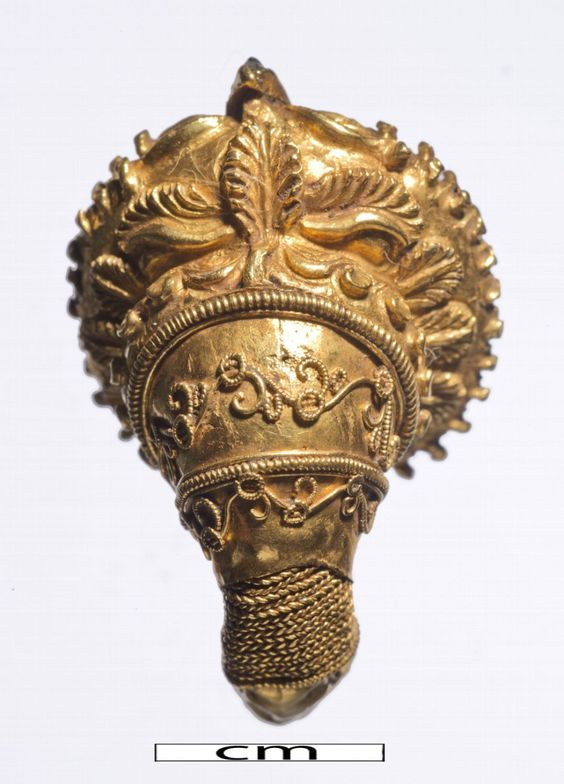
Terminal of an earring in the shape of lion’s head; gold and garnets; Syria, ca 300 BCE.
to compare
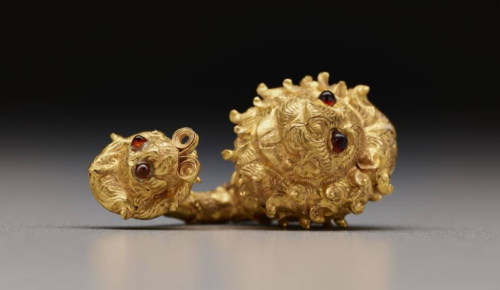
A lion head gold earring with garnets. Greek, 3rd C BCE
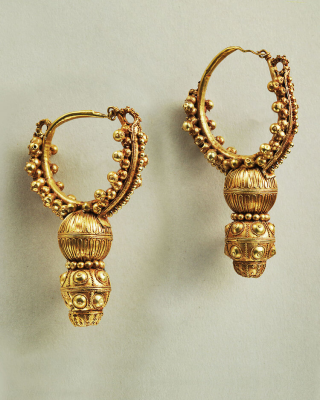
Gold, L: 6.7 cm
Provenance: Sotheby’s, London, 12-13 December 1983, lot 145
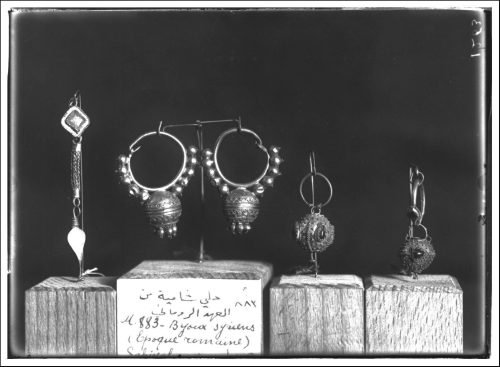 Gold jewelry, Roman period. Damascus Museum
Photo ©Institut Français Du Proche-Orient (ifpo)
https://media.hal.science/hal-03041923v1
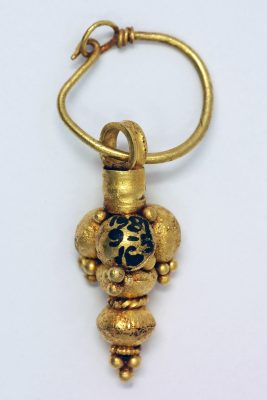
“The jewelry is made entirely of gold. The earrings are composed of two elements: the hoop, which was inserted into the earlobe, and the pendant fixed to the underside of the ring. The hoop is a circular wire with the clasp at the top; it is decorated with a series of small cast spheres. The pendant was formed from two spheres positioned vertically and separated by a granulated frieze: some geometric motifs (points in relief, wires forming ample waves) ornament the surface of the pendant. This type of jewel is well documented throughout the eastern part of the Roman empire (Syria, Jordan).” Sotheby’s
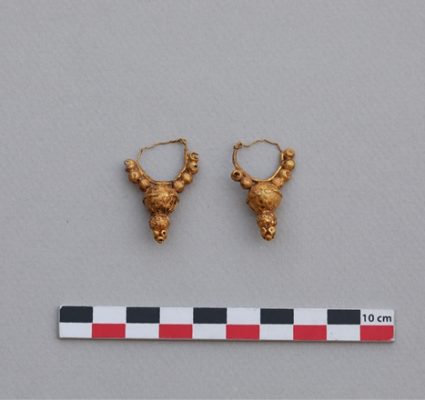
Source: https://www.jinshasitemuseum.com/info/750
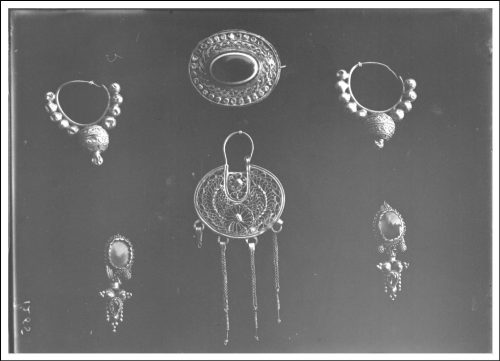
Photo ©Institut Français Du Proche-Orient (ifpo)
https://media.hal.science/hal-03041928v1
Related posts:
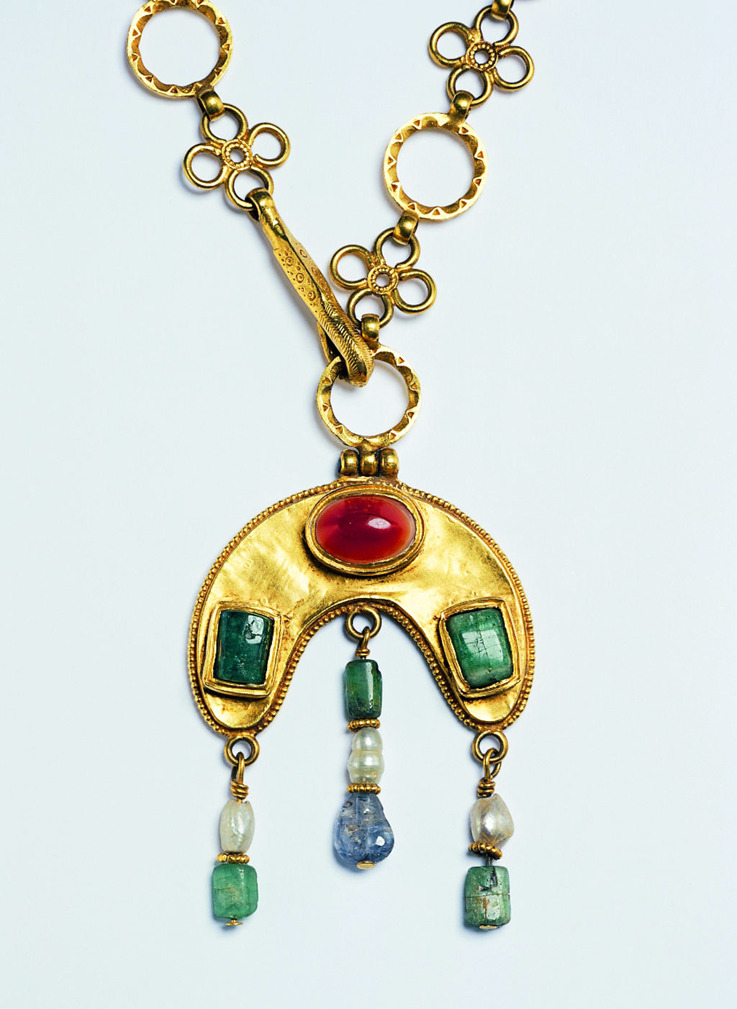 Necklace with a lunula pendant, Syria; Byzantine, 600 CE [d/b]
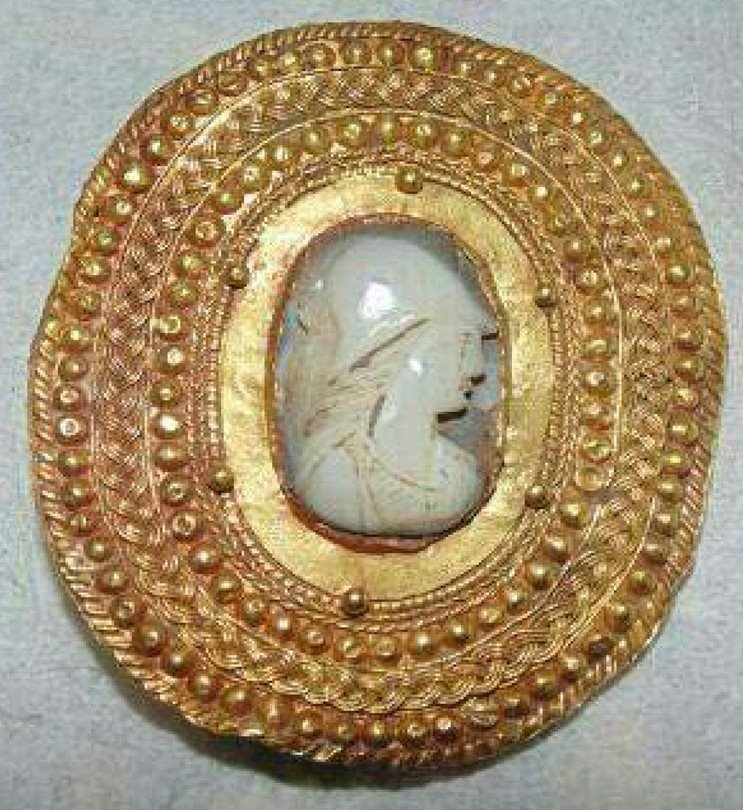 Brooches Roman era – an overview
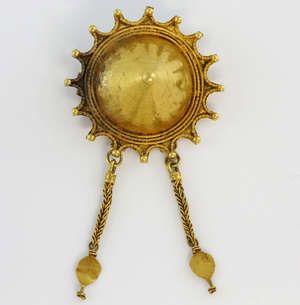 Medallions with a sun motif
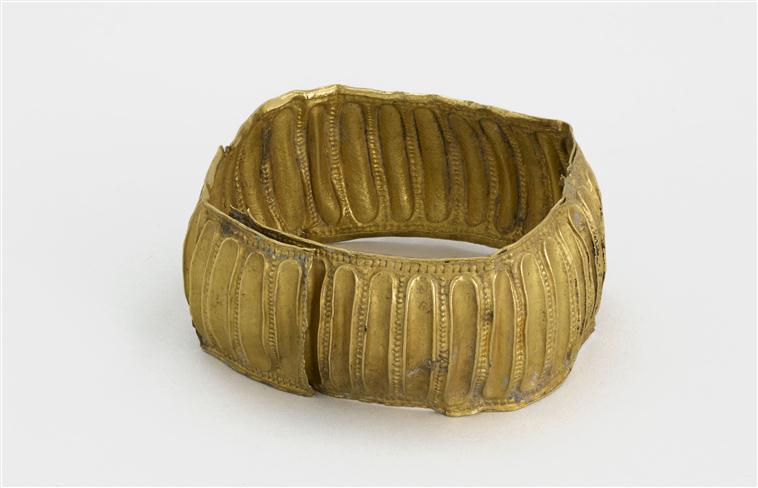 Massive bracelets of the Roman period
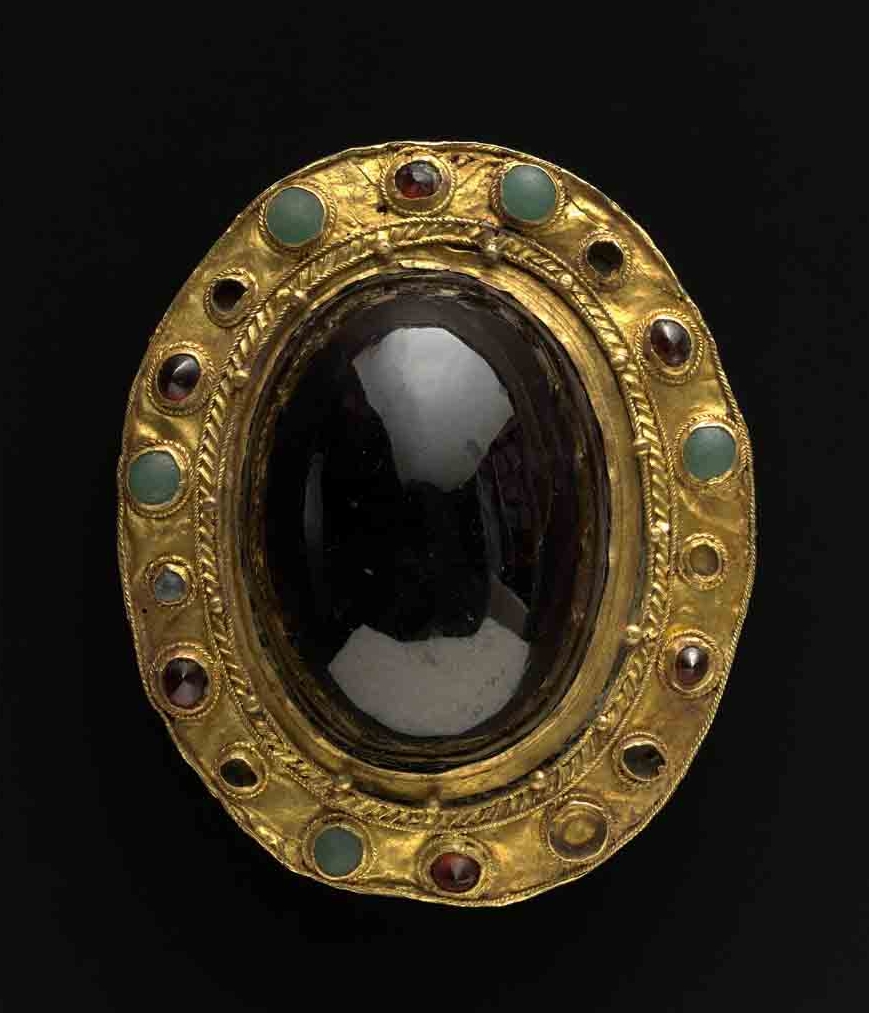 Brooch with sapphire, 1st-2nd century [d/b]
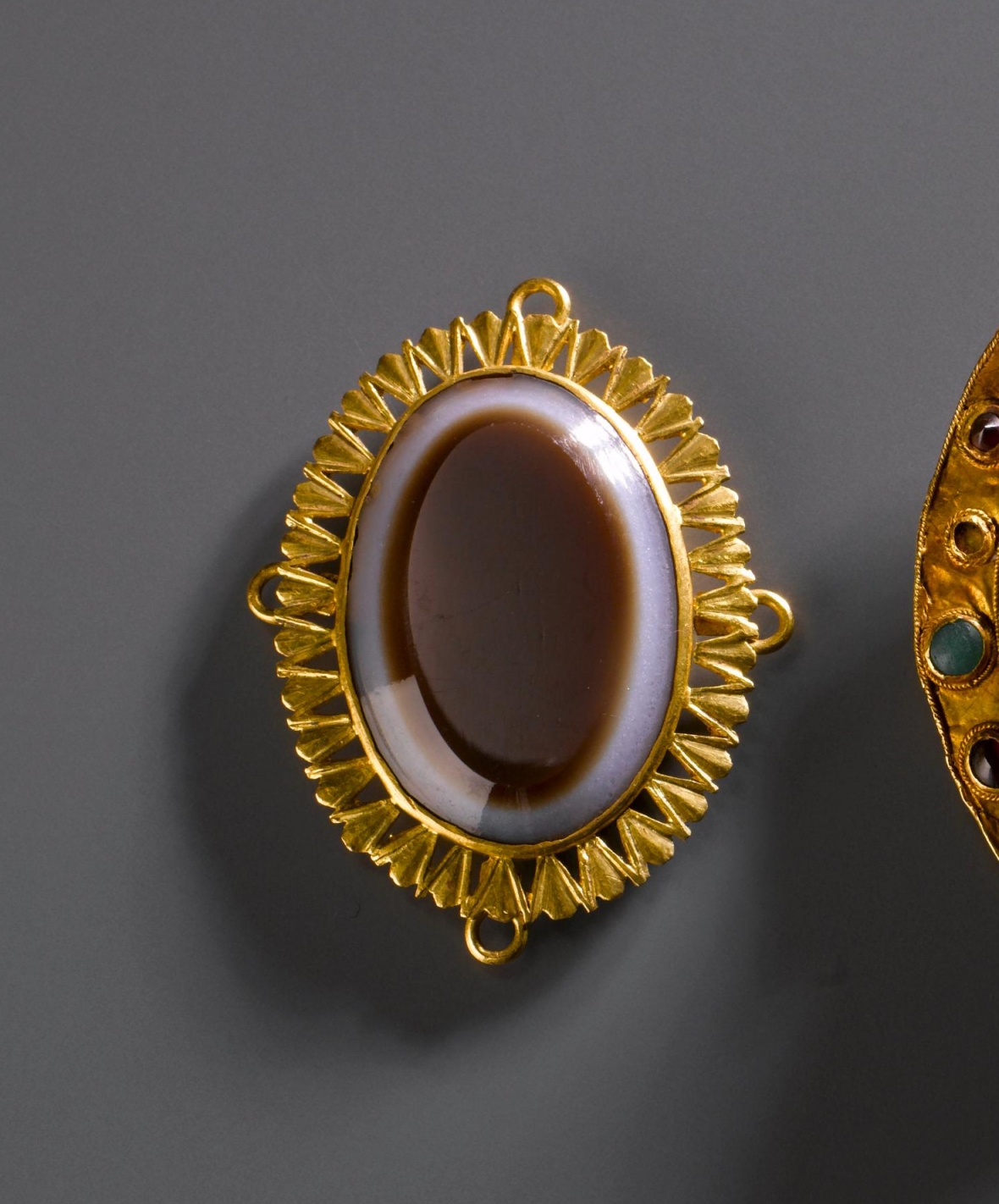 Medallion with sardonyx, 3rd century, Syria [d/b]
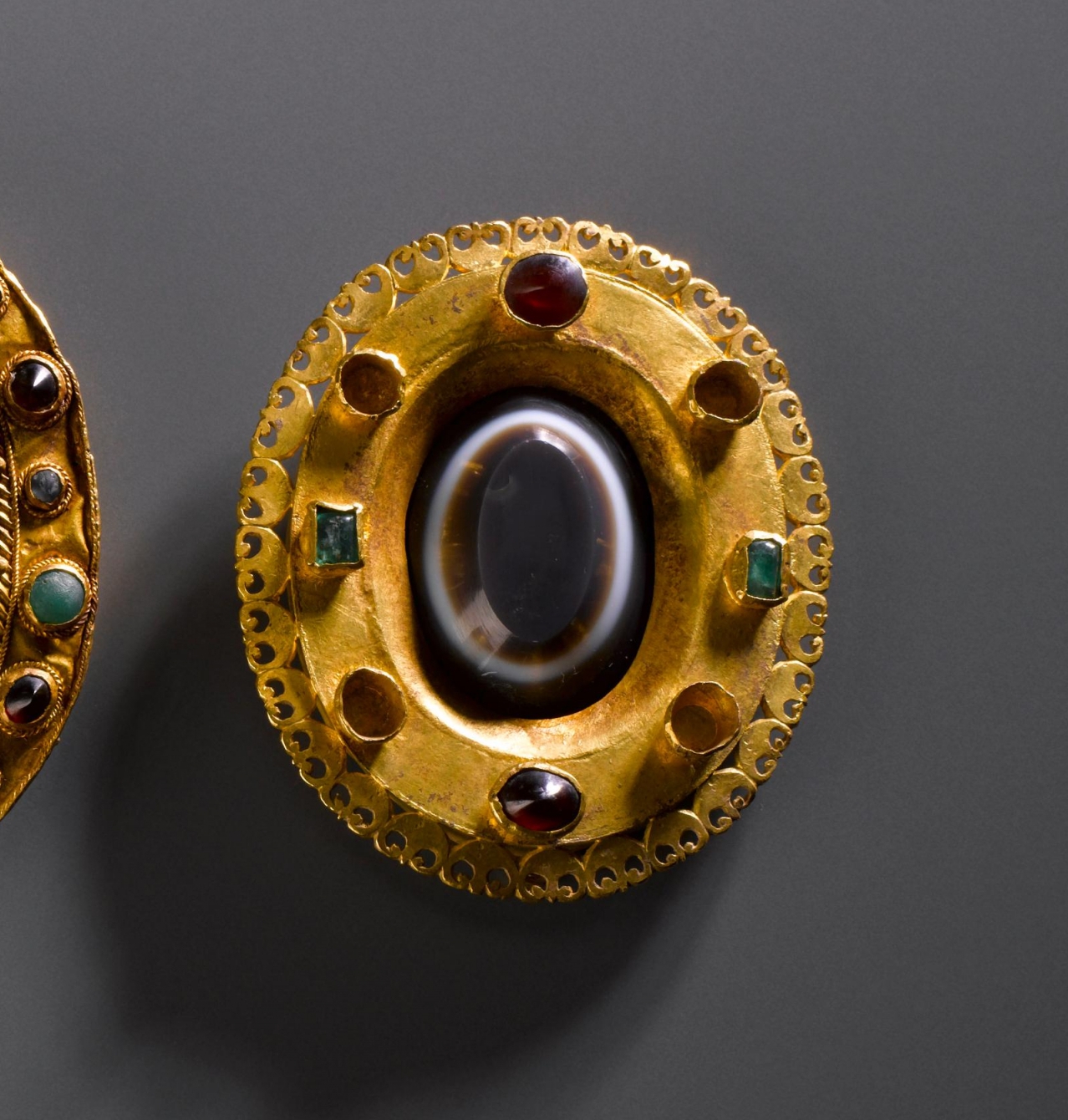 Brooch with sardonyx, 3rd century, Syria [d/b]
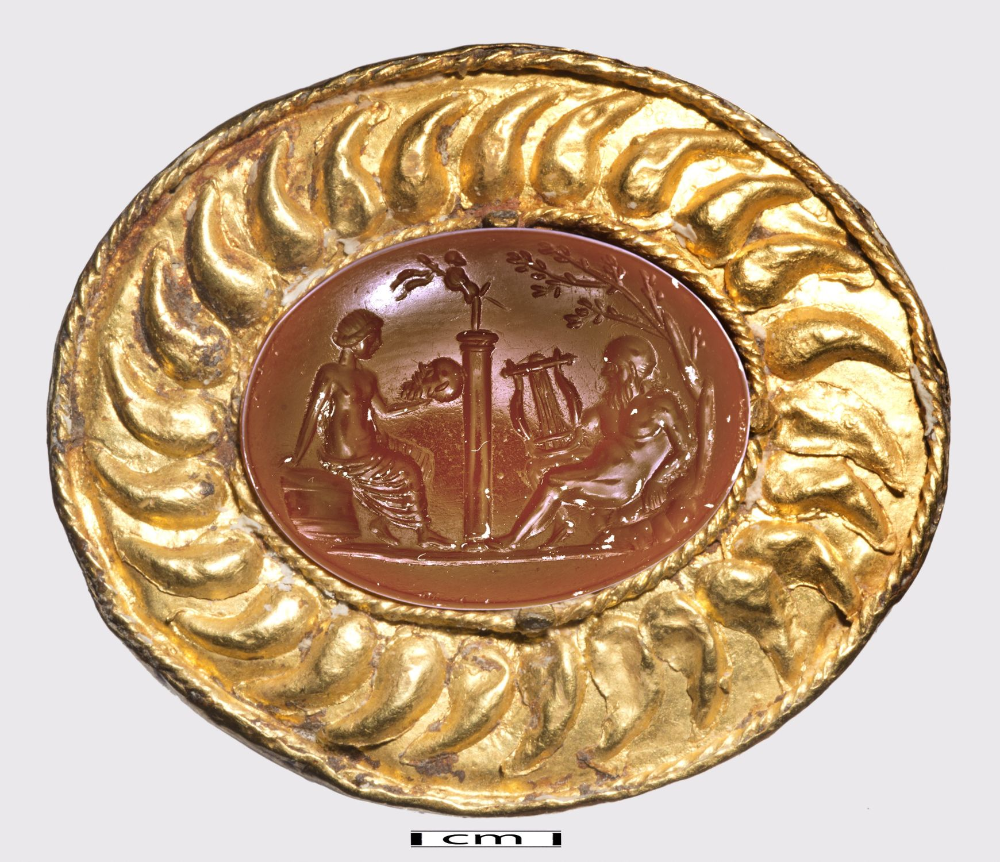 Gold brooch with an intaglio, Tartus, Roman time Syria [d/b]
Jewelry from Syria – Late antique / Byzantine period [4th century +]
Gold brooch with an intaglio, Tartus, Roman time Syria [d/b]
Jewelry from Syria – Late antique / Byzantine period [4th century +]
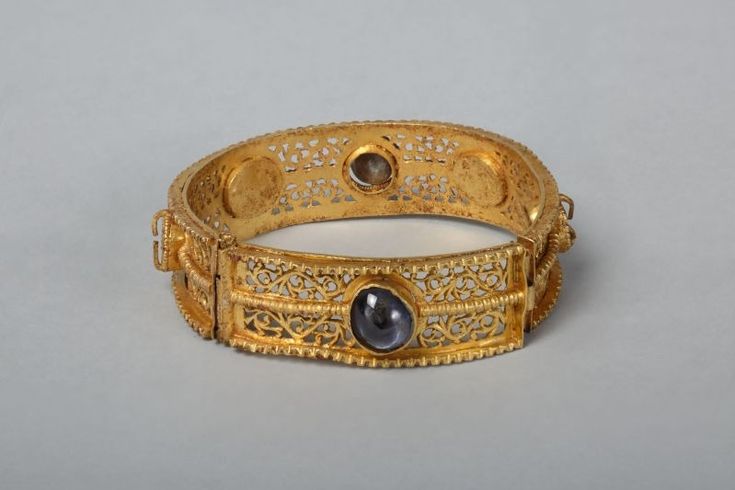 Bracelet [cuffs], 2nd-3rd century, Syria [d/b]
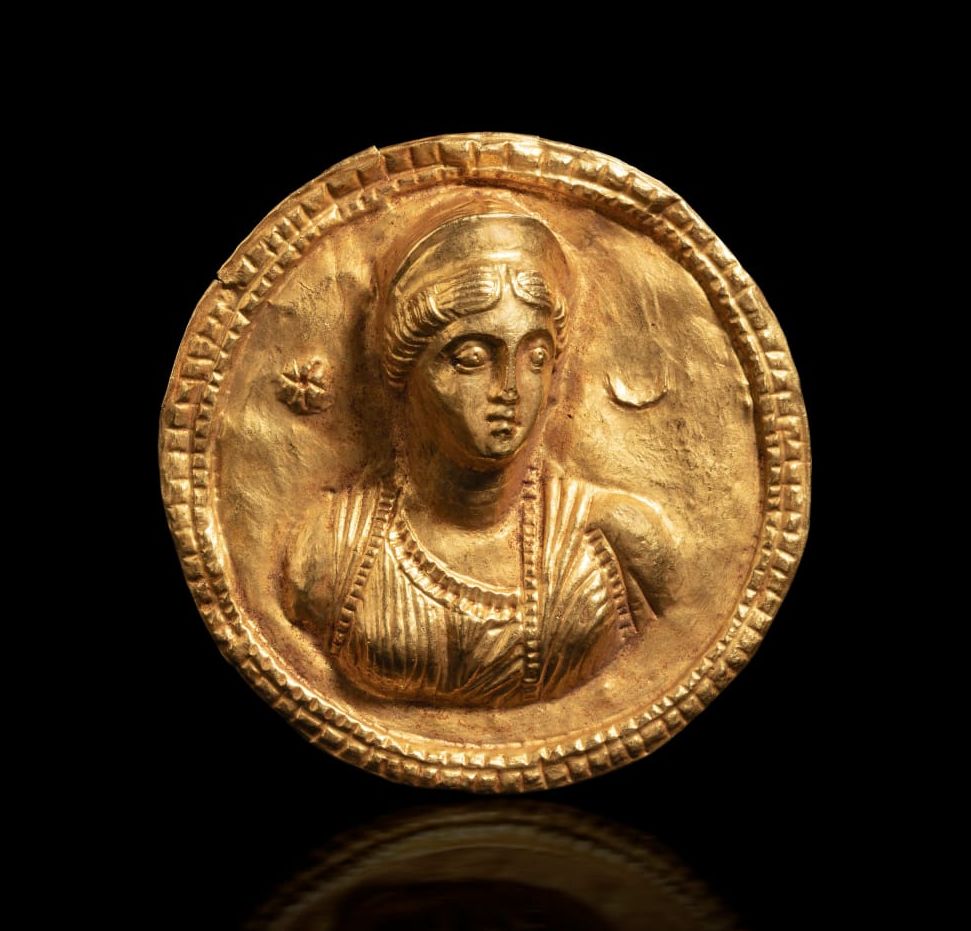 Medallion with Aphrodite, 2nd-1st century BCE, Hellenistic Syria [d/b]
 Parthian pendant / brooch – an overview