The Metropolitan Museum https://www.metmuseum.org
https://www.peopleofar.com/2013/02/19/armenian-medallion-from-urartu-period-8th-7th-c-b-c/
Królestwo Urartu, które w VIII wieku p.n.e. panowało we Wschodniej Anatolii, skupionej wokół jeziora Wan i jego okolic
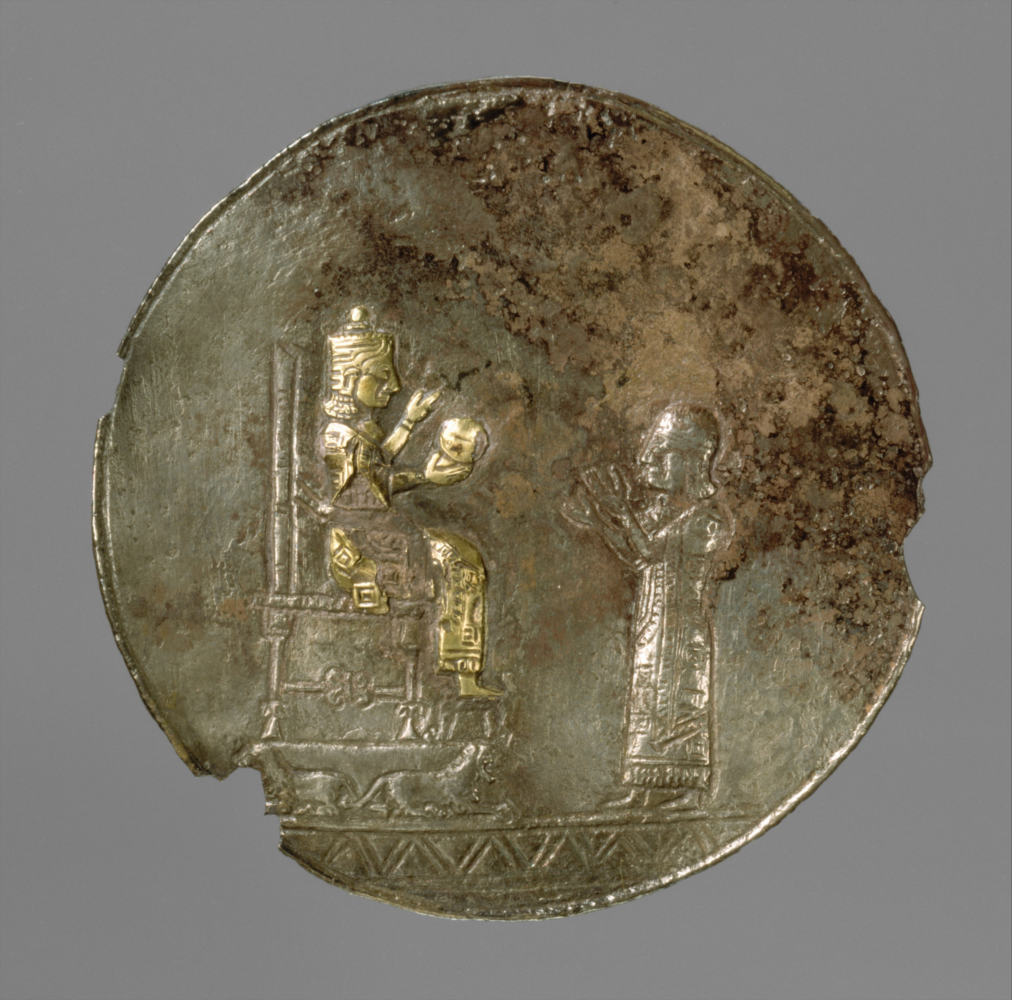
The kings of Urartu ruled what is now eastern Turkey, Armenia, and northwestern Iran from their capital at Tushpa (modern Van, Turkey) during the early first millennium B.C. Urartian fortresses, strategically placed on high rock outcrops, dominated the landscape of their territories and protected the kingdom from their rivals, the Assyrians. Despite confrontations with the Assyrians, the Urartians also borrowed many images and iconographic elements from Assyrian art and made them their own.
This silver medallion, partially covered with gold foil, shows a deity seated on a throne supported by lions facing a male worshiper whose arms are raised in supplication or respect. Both the deity with horned headdress on a throne supported by animals and the worshiper figure are common Assyrian motifs; the long fringed garments are widespread in the ancient Near East. Here, the scene is set on a ground line of paired zigzag lines between pairs of parallel horizontal lines, a decorative pattern characteristic of Urartian medallions. Such medallions in silver, gold, and bronze are thought to be insignias of rank and authority and have been found at sites in both Armenia and Turkey.
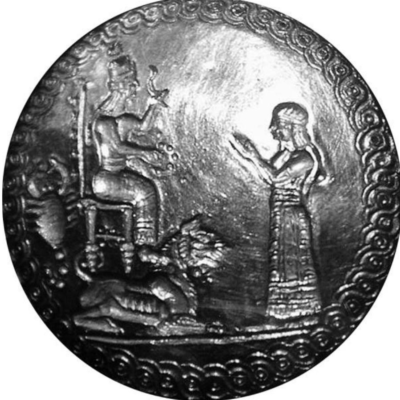
Hama’s golden stamp seal is inscribed on the edge with her name and title. It shows a queen wearing a long dress and a diadem with a ribbon trailing down her back. With both hands raised, she approaches the goddess Ishtar/Mullissu, who is seated on a high- backed and star-studded throne, that is placed on top of a lion. Behind the goddess is a scorpion. The whole scene is encircled by a guilloche.
Seal of Queen Hama, Assyria, ca. 782-773 BCE. Gold; diameter 3.2 cm. Iraq Museum, Baghdad, ND 1989.334.
The queen possessed her own crown, the so-called mural crown (Akkadian kililu, meaning “battlements”). The seated female figure in the Garden Scene wears this crown, marking her as an Assyrian queen. Textual sources from Assyria make clear that only one woman at any given moment held the title of queen. Assyrian queens are also sometimes depicted without a crown, but with the royal diadem, in similar cultic contexts as the king. A good example appears on a seal of Hama, queen of Shalmaneser IV (782-773 BCE): a female figure, presumably Hama herself, is shown wearing the royal diadem and standing in front of the healing goddess Gula [Mullissu/Ištar]
David Kertai, Libbali-sharrat in the Garden: An Assyrian Queen Holding Court https://www.academia.edu/101049751/Libbali_sharrat_in_the_Garden_An_Assyrian_Queen_Holding_Court
2020_Women and Seals in the ancient Near East
By Agnete Wisti Lassen and Klaus Wagensonner https://www.academia.edu/42101203/2020_Women_and_Seals_in_the_ancient_Near_East
scorpion https://epub.ub.uni-muenchen.de/24984/1/oa_24984.pdf
https://discovery.ucl.ac.uk/id/eprint/19839/1/Radner_2008_Delegation_of_power.pdf
Since late Kassite times, the scorpion is attested as a symbol for the goddess Išhara who shows a variety of characteristics from being a goddess of love, mother goddess and goddess of extispicy to being a war goddess. https://www.academia.edu/130399385/In_the_sign_of_the_scorpion_The_administrative_seals_of_the_Neo_Assyrian_queen_and_the_queens_household
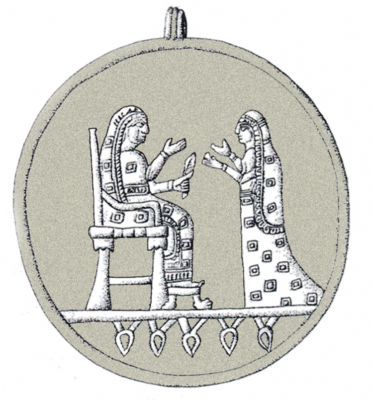
A gold medallion from Toprakkale (diameter 6.5 cm, 1 mm thick), shows a seated goddess and a female worshipper wearing long tunics and veils and nested square motifs [Ali Çifçi]. State Museum of Berlin
cast >> https://www.britishmuseum.org
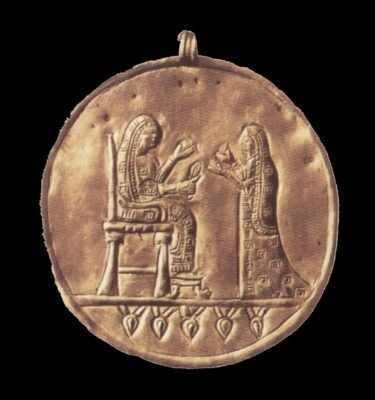
Image courtesy of İlknur Özgen https://sardisexpedition.org
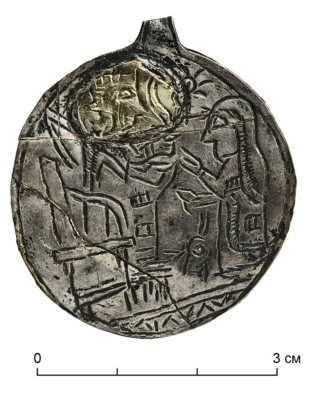
Серебряный медальон, Кармир-Блур, Музей истории Армении [Gayane R. Poghosyan]
A silver medallion (3.5 cm, 8th-6th century BCE), discovered at Karmir Blur in Area B during excavations
of the northern sector of the citadel’s central part in 1951-1952, depicts a sacrificial scene. “The composition,
adapted to the medallion’s circular surface, shows a female figure sacrificing a goat to a deity seated on a throne. While B. Piotrovski identified the throned figure as a goddess, it is more likely a depiction of the male deity Haldi.
This same figure also appears on a
gold medallion from Toprak-Kale, which B. Piotrovski [7, p. 84] interpreted as a scene of adoration to the goddess Arubaini (Haldi’s wife)”
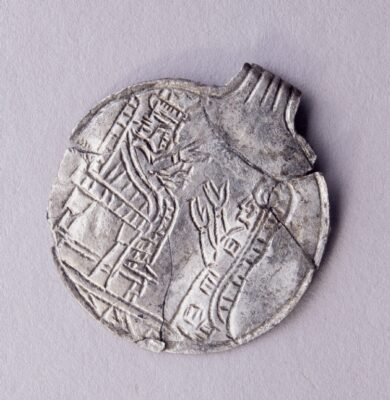
The woman standing against the goddess who is sitting on the throne in Toprakkale gold medal is probably shown in the prayer position. “Two silver medallions of the same scenes were unearthed in Karmir-Blur, a cult or votive scene has been portrayed. In the same group, a small pectoral (breastplate) found in Toprakkale, which we can evaluate in the same group, this time depicts a woman with a goat, wearing a headscarf in the face of a goddess sitting on a throne in the middle of two trees of life.”
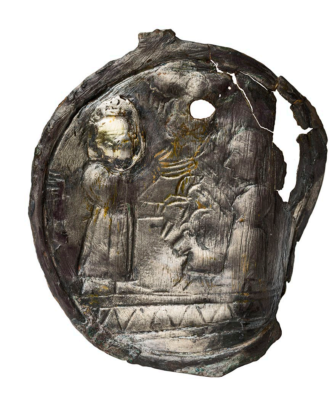
Серебряный медальон, Кармир-Блур, Музей истории Армении [Gayane R. Poghosyan]
Another silver medallion from Karmir Blur (Area B, 5 cm, 8th-6th century BCE) also features a circular
gilding decoration. “The artistic decoration on both medallions is schematic and simple, created using
an engraving technique where a sharp tool incised the metal surface. This second medallion depicts a standing figure offering a goat to a deity.”
- Ali Çifçi, Textiles in the Urartian Kingdom https://www.academia.edu/7375208/Textiles_in_the_Urartian_Kingdom
- Gayane R. Poghosyan, THE DEPICTION OF HALO IN THE ARTISTIC DESIGN OF URARTIAN MEDALLIONS
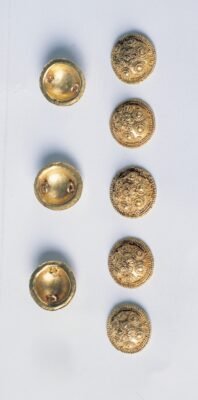
Najwspanialsze przykłady guzików wykonanych ze złota, srebra i antymonu z okresu Królestwa Urartu odkryto w grobowcach rodzinnych władców w Altıntepe. W sarkofagu, w którym pochowano kobietę w jej szacie, guziki zdobiące szatę są zdobione motywami rozet, mają wypukły środek i są zdobione techniką granulacji.
Zdjęcie: Füsun Kavrakoğlu, Muzeum Cywilizacji Anatolijskich , 2018.https://kavrakoglu.com/urartu
Guziki (40 sztuk)
wysokość: 0,5 cm, średnica: 2 cm.
Waga: 2,97 – 3,87 gr.
Okres urartyjski: koniec VIII w. p.n.e. – początek VII w. p.n.e.
Related posts:
 Parthian pendant / brooch – an overview
 Gold jewelry from Gerulata (Rusovce), 2nd-4th C; Roman time Slovakia
 Silver medallion from Sisian, Armenia, 2nd C BCE [D/B]
 Rosette patterns on vessels
 Brooch / medallion, 4th century, Ukraine [d/b]
 Disc-shaped headdress ornaments, Egypt, ca. 2100 BCE
 Inlaid Rosette, Egypt, 1427–1400 BCE [d/b]
 Medallion from Ur [Iraq], Temple of Sin, 700-500 BCE [d/b]
 Brooch-medallion from Kythnos, Greece [d/b]
 Gold medallion from Gorgippia, Aphrodite – Urania – Artemis, 1st century [d/b]
 Gold medallion from Gorgippia, Aphrodite Urania Apatura, 1st-2nd century [d/b]
 Gold and lapis belt from the Patti Birch collection; Iran, 4th-5th century [d/b]